Expanding your business across regions comes with unique challenges—from coordinating teams in different time zones to tailoring strategies for local markets. A well-designed geographical organizational structure helps you tackle these challenges by empowering regional teams to make fast, informed decisions while keeping the company’s overall vision intact. In this guide, you’ll discover practical tips, real-world examples, and actionable steps to create an org chart for your regional structure that scales efficiently and keeps every part of your business aligned.
What Is a Geographical Organizational Structure
A geographical organizational structure is a way of organizing a company based on regions, territories, or countries. Instead of grouping teams by function, product, or customer type, this structure divides operations according to location. Each region typically has its own management team responsible for local decisions, operations, and performance, while still aligning with the company’s overall strategy.
This setup works especially well for businesses that operate in multiple markets with distinct customer needs, cultural differences, or regulatory requirements. By giving regional teams more autonomy, companies can respond faster to local opportunities, improve customer satisfaction, and maintain accountability at every level.
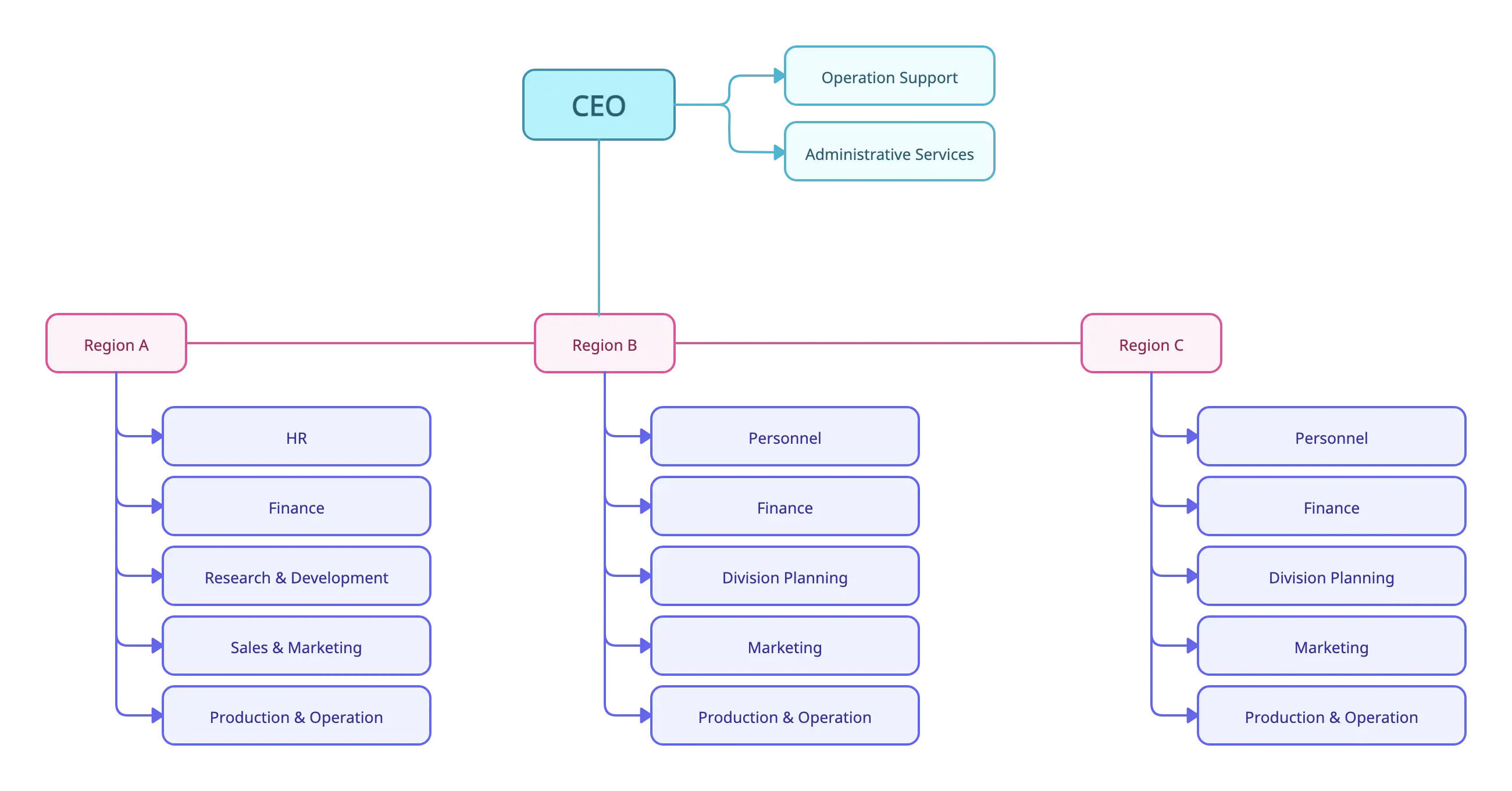
Key Components of a Geographical Organization Structure
At its core, a geographical organizational structure is all about putting the right people and processes in the right places so your business can thrive locally while staying connected globally. Here’s what makes it tick:
1. Regional divisions: The foundation of this structure is dividing your business into clear geographic regions—countries, zones, or clusters. Each region becomes a semi-independent unit, focusing on local markets and customer needs.
2. Regional leadership: Every region needs strong leaders—managers or directors who understand local culture, market trends, and regulations. They’re the ones making fast, informed decisions without waiting for the head office to weigh in on every little thing.
3. Central vs local functions: While regions handle day-to-day operations, central teams keep the bigger picture in check. Finance, HR, IT, or corporate strategy often stay centralized to maintain efficiency and consistency. The key is finding the right balance between local autonomy and central oversight.
4. Clear reporting lines: To avoid confusion, each regional team should know exactly who they report to and which decisions they can make independently. A well-defined hierarchy keeps communication smooth and ensures accountability at every level.
5. Decision-making autonomy: Empowering regional teams to make the right calls quickly is what makes this structure effective. The goal isn’t to micromanage from headquarters—it’s to give each region the tools, authority, and guidance to succeed on its own terms.
Types of Geographical Organizational Charts
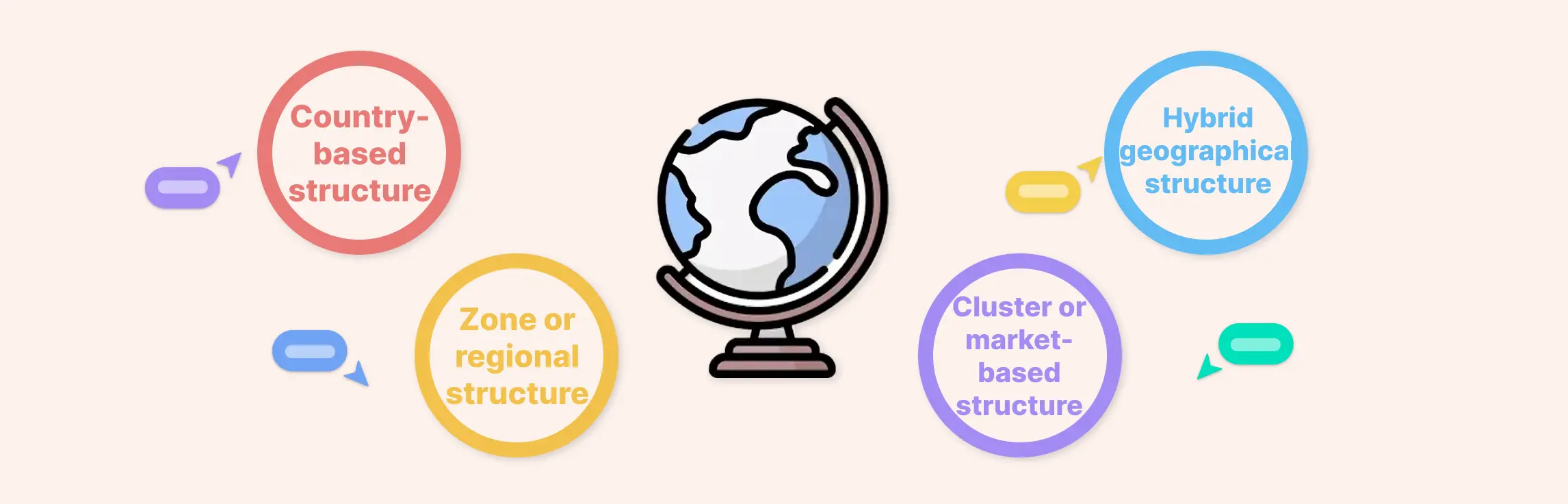
1. Country-based structure
Each country operates as a separate division with its own regional manager and teams for sales, marketing, and operations.
Best for businesses operating in a few large countries with distinct markets.
2. Zone or regional structure
Multiple countries or areas are grouped into zones (e.g., North America, Europe, Asia-Pacific).
A zone manager oversees several countries, each with local teams reporting to the zone manager.
Useful for companies with operations across many countries but wanting fewer management layers.
3. Cluster or market-based structure
Regions are divided based on market similarities rather than strict geographic boundaries (e.g., grouping countries with similar customer behaviors or regulatory environments).
Helps companies standardize operations across markets that behave similarly, even if they are geographically distant.
4. Hybrid geographical structure
Combines geographical divisions with other organizational structures, such as product or functional teams.
Example: Each region has its own sales and operations teams, but product development or marketing strategy remains centralized.
Provides a balance between local autonomy and centralized efficiency.
When to Use a Geographical Business Structure
1. You operate in multiple locations
If your business has offices, stores, or branches in different cities, states, or countries, a geographical structure helps each location manage itself efficiently while staying aligned with corporate goals.
2. Local markets have unique needs
Different regions often have distinct customer preferences, cultural norms, or purchasing behaviors. A regional structure lets local teams tailor products, marketing, and services to fit their market perfectly.
3. Regulatory or legal requirements vary by region
Some industries face rules that differ from one location to another. Regional teams can ensure compliance without slowing down operations across the whole company.
4. Fast decision-making is critical
When decisions need to be made quickly—like responding to a market trend, a competitor move, or a customer issue—regional teams with autonomy can act immediately without waiting for headquarters approval.
5. You want accountability and performance tracking by region
A clear regional structure allows you to measure results, track profitability, and hold each region accountable for its own performance.
How to Build an Effective Geographical Structure
One of the easiest ways to make your geographical structure real is by visualizing it in an online organizational chart. It’s not just about drawing boxes—it’s about showing who is responsible for what, where decisions are made, and how regions connect to headquarters. Here’s how to design a clear and effective chart:
Step 1: Start with headquarters (central functions)
Place the CEO or executive team at the top.
Include central departments like Finance, HR, IT, Legal, and Strategy.
These teams guide company-wide decisions and provide support to regions.
Tip: Use one color or style to visually separate headquarters from regions.
Step 2: Define your regions clearly
Decide how to divide your operations: countries, zones, or clusters of markets.
Each region becomes a major branch under headquarters.
Example: North America, Europe, Asia-Pacific, or East Coast, West Coast, Central.
Step 3: Add regional leadership
Place regional managers or directors under each regional branch.
Include key roles like operations manager, sales director, or marketing lead.
These leaders are responsible for making local decisions and reporting performance to headquarters.
Step 4: Include local teams under each region
Break down each region into functional teams: sales, marketing, customer service, logistics, or operations.
This shows who handles day-to-day tasks and ensures accountability.
Tip: Keep boxes simple and label roles clearly; avoid crowding the chart.
Step 5: Show reporting lines and decision-making authority
Draw solid lines for direct reporting (manager → team).
Use dashed lines for dotted-line reporting or decisions that require headquarters approval.
Clearly indicate which decisions are local and which need central oversight.
Step 6: Highlight central vs local functions visually
Use different colors, shapes, or labels to distinguish headquarters from regional teams.
This helps everyone quickly see which parts of the organization are centralized and which operate independently.
Step 7: Keep it simple and scalable
Avoid adding too many layers at once. Start with key regions and main teams.
As the business grows, expand the chart with new teams or sub-regions.
Tip: Consistency is key—use the same format, fonts, and style throughout.
Step 8: Use an org chart tool to make updates easy
Creately makes creating and maintaining a geographical org chart simple. With pre-made templates, a drag-and-drop interface, and real-time collaboration, you can quickly add regions, teams, or roles and keep your chart up to date. Its visual styling options make it easy to distinguish headquarters, regions, and local teams, helping everyone understand the structure at a glance.
Step 9: Review and validate with stakeholders
Share the draft org chart with regional managers and central teams.
Make sure reporting lines are clear and decision-making authority is realistic.
Adjust based on feedback before finalizing.
Geographical Structure vs Other Organizational Structures
Understanding how a geographical structure compares to other common organizational structures can help you decide if it’s the right fit for your business. Let’s break it down in a simple, relatable way:
| Structure Type | How Teams Are Grouped | Key Advantage | Key Difference vs Geographical Structure |
| Functional | By function (e.g., marketing, sales, operations) | Specialization and efficiency | Geographical focuses on local responsiveness; functional focuses on centralized expertise |
| Product | By product or product line | Product focus and innovation | Geographical organizes by region, managing all products locally |
| Market/Customer | By customer type or segment | Tailored customer solutions | Geographical focuses on region, not customer type |
| Matrix | Dual reporting (e.g., function + product/region) | Multi-dimensional oversight | Geographical simplifies reporting with one manager per region |
Free Geographical Organizational Chart Templates
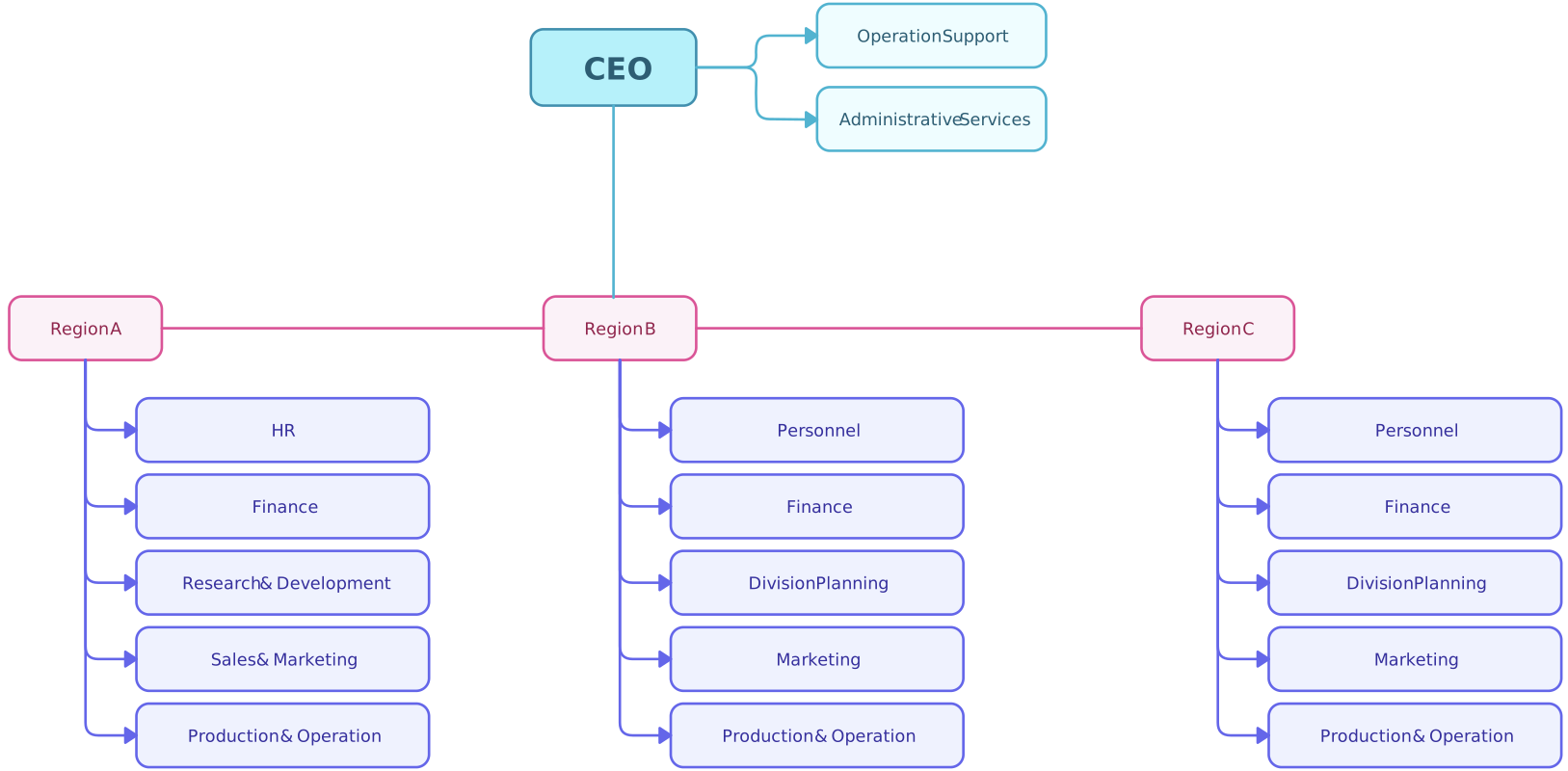
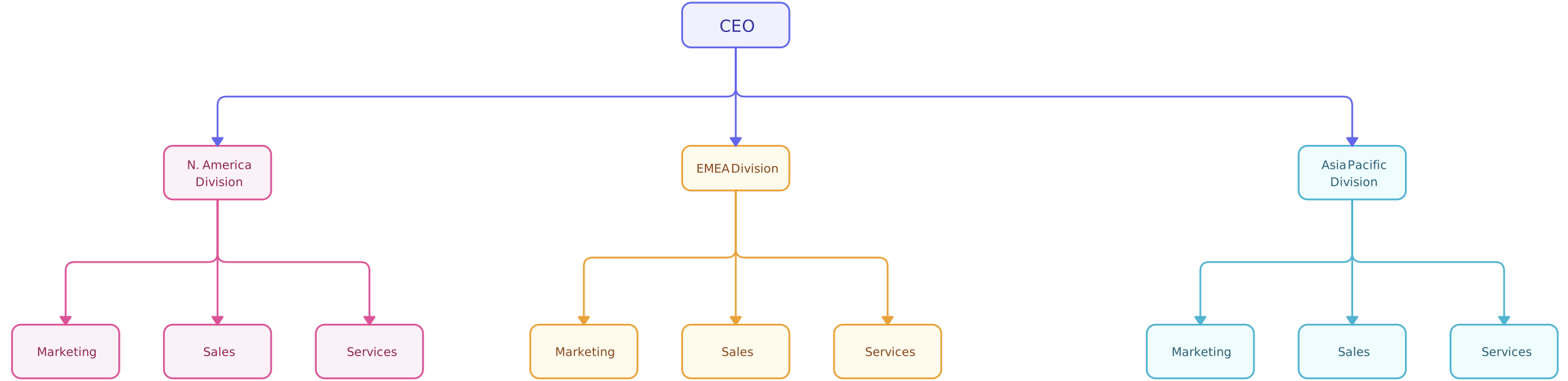
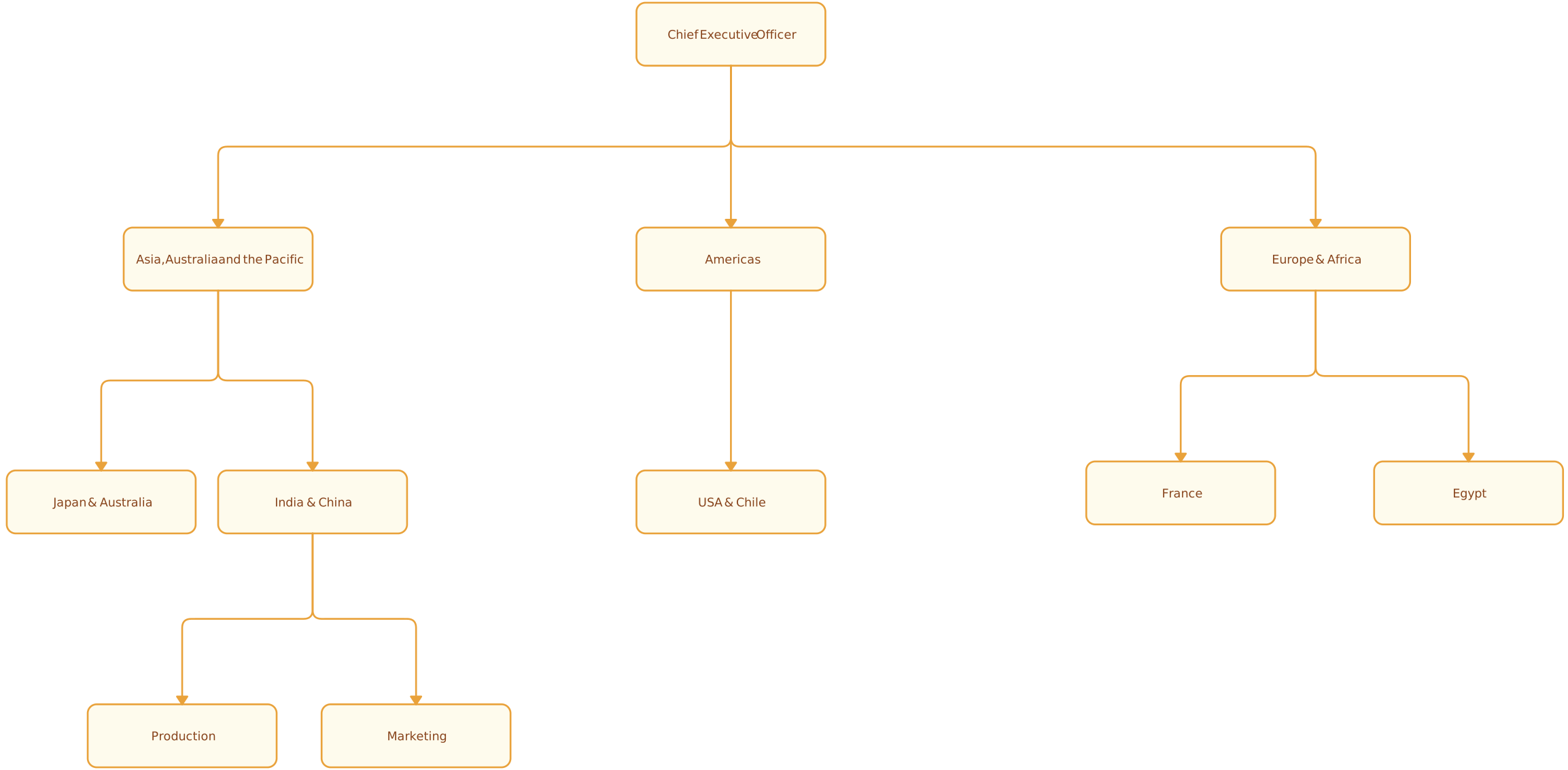
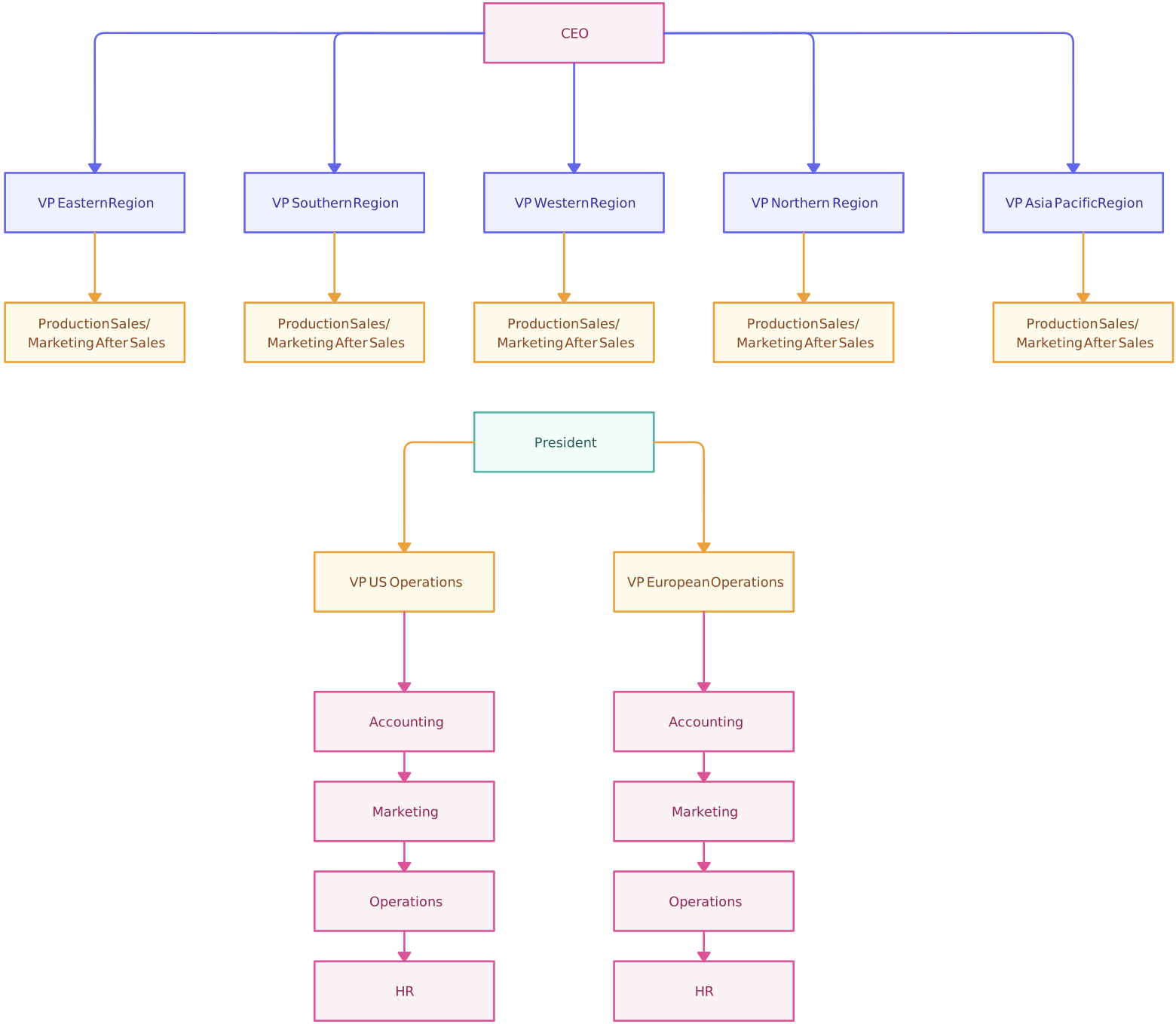
Now that you know what a geographical org structure is, here are some geographic org diagrams to help you get started on visualizing your structure.
Geographical Organizational Chart

Geographical Divisional Structure
Global Geographic Division Structure
Matrix Organization Divisions By Geographical Locations
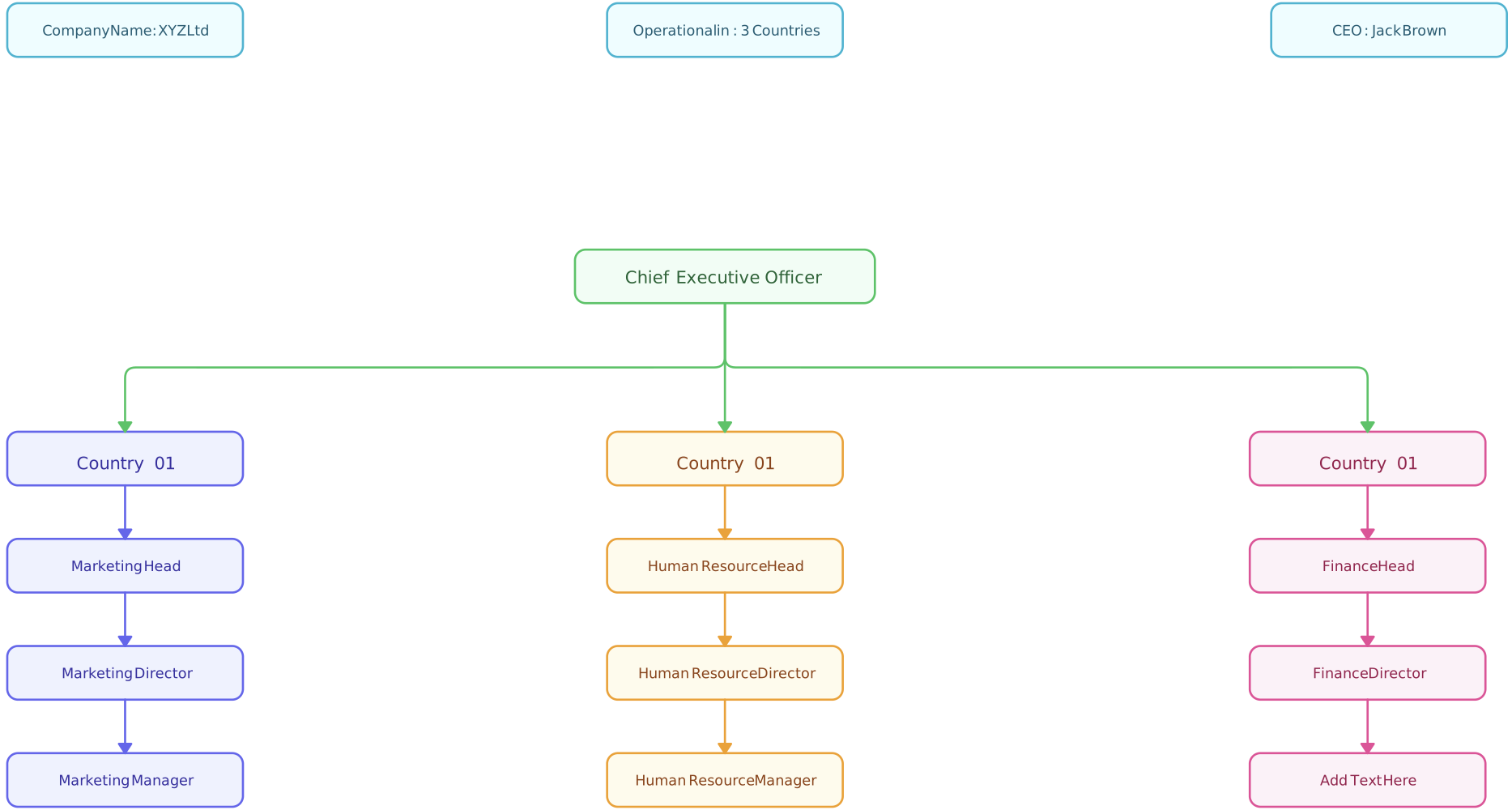
Regional Organizational Chart Template
Helpful Resources
Learn what a product organizational structure is, explore common team models, key roles, pros and cons, and how to build a scalable product org chart.
Project organizational structure explained. Learn types, how to choose the right model, and use pre-made templates to map roles and reporting lines.
Learn the difference between functional and divisional organizational structures, with examples, pros & cons, a comparison table and guidance on which to choose.
Team‑based organizational structure: definition, benefits & drawbacks, best practices, and real‑world examples with free templates.
A practical guide to the matrix organizational structure with step-by-step instructions for creating clear matrix org charts, real company examples, free templates, pros & cons, and implementation tips for managers.
Learn what a hybrid organizational structure is, explore its types and key characteristics, and discover how to implement it effectively with free templates.
Learn what a decentralized organizational structure is, its benefits and drawbacks, real company examples, and steps to implement decentralization in your business.
Advantages and Disadvantages of Geographical Structures
| Advantages | Disadvantages |
| Faster local decision-making – Regional teams can respond quickly to market changes, customer needs, and operational issues without waiting for headquarters approval. | Duplication of resources – Each region often has its own marketing, sales, or operations teams, which can lead to overlap and inefficiency. |
| Better understanding of local markets – Teams on the ground know customer preferences, cultural nuances, and competitors, allowing for tailored strategies. | Higher operational costs – Maintaining multiple regional offices, teams, and resources can be more expensive than a centralized setup. |
| Improved customer service – Local teams can address customer issues faster and provide solutions that meet regional expectations. | Inconsistent strategy or brand – If regions operate too independently, company-wide strategy, policies, or branding may vary. |
| Regulatory compliance and risk management – Regions with unique legal or industry requirements can ensure compliance locally without slowing down the entire company. | Coordination challenges – Aligning multiple regions toward common goals can be difficult, especially across time zones and cultures. |
| Clear regional accountability – Each region has its own performance metrics, making it easier to measure results and hold teams responsible for outcomes. | Risk of internal competition – Regions may compete for resources, recognition, or market share, which can create tension and inefficiency. |
FAQs About Geographical Organizational Charts
Who should use a geographical organizational chart?
How do I decide the regions for my org chart?
Who reports to whom in a geographical org chart?
Can I combine a geographic structure with other structures?
How can I make my geographical org chart easy to update?
What are geographic divisions?